
Buyer Guide
How International Buyers Should Evaluate Mineral Suppliers in the DRC and South Africa
A buyer's framework for vetting DRC and South African mineral suppliers: identity, site and origin, chain of custody, independent assay, permits, KYC/AML, logistics, insurance, payment safeguards and red flags.
Published
By Afrimet Global Resources
Start with evidence, not the offer
International buyers sourcing gold, copper, cobalt, lithium, coltan or cassiterite from the Democratic Republic of the Congo (DRC) or South Africa often receive offers that look complete: a specification sheet, a price indication, a few photographs and an urgent deadline. None of those establish who the seller is, where the material came from, or whether it can legally be exported and delivered. Supplier evaluation is the process of turning each claim into a document that can be checked independently.
This guide sets out a practical evaluation sequence. It is framed around public references such as the OECD Due Diligence Guidance, the ICGLR Regional Certification Mechanism and the FATF Recommendations, but every buyer's obligations depend on its own jurisdiction, bank, refinery or smelter and internal policy. Treat the steps below as a structure to adapt, not as a statement of what any law requires in your case.
1. Supplier identity and authority
Counterparty
Identify the legal entity that will sign the contract and receive payment. Request the certificate of incorporation, registered address, directors and ultimate beneficial owners, and check them against official sources — in South Africa, the Companies and Intellectual Property Commission (CIPC) register; in the DRC, the commercial register (RCCM) and national identification records, ideally via a local adviser.
Then confirm authority to sell. Brokers and intermediaries are common in this trade; an intermediary should hold a written mandate from the title holder, and the buyer should verify that mandate directly with the title holder rather than through the intermediary.
- Registration documents and beneficial-ownership declaration, checked against a registry
- Named signatory with documented signing authority
- Written, directly confirmed mandate for any agent or broker
- Bank account held in the contracting seller's own legal name
2. Mine, site and origin verification
Origin
Ask for the specific mine or site of origin, the mining right under which material was produced and, where the seller is a trader, the documented purchase from that producer. In the DRC, mining titles are recorded by the Cadastre Minier (CAMI); an exploration permit does not authorise production, and a mining title does not by itself authorise a third party to export. In South Africa, mining and prospecting rights are granted by the Department of Mineral and Petroleum Resources, and dealing in precious metals such as gold is regulated separately, including through the South African Diamond and Precious Metals Regulator.
Where practical, commission an independent site visit or rely on a reputable third-party inspector. Coordinates, photographs and production figures supplied by the seller should be consistent with the title area and with the volumes being offered. A seller unable to name the origin site should not progress.
3. Chain of custody
Traceability
A credible chain of custody is a reconciled record of every party that held the material — producer, trading counter, processor, warehouse, exporter, freight forwarder — with dates, weights and lot or bag identifiers that match from document to document. The OECD Guidance asks buyers to assess risks such as conflict financing, serious human-rights abuses and illegal taxation, which is particularly relevant where minerals originate in or transit through conflict-affected parts of eastern DRC.
For tin, tantalum, tungsten and gold, ICGLR regional certification applies in the DRC. For gold, many refiners apply the LBMA Responsible Gold Guidance to their suppliers. Ask your own receiving refinery or smelter which evidence it will accept before you sign.
4. Independent sampling and assay
Quality
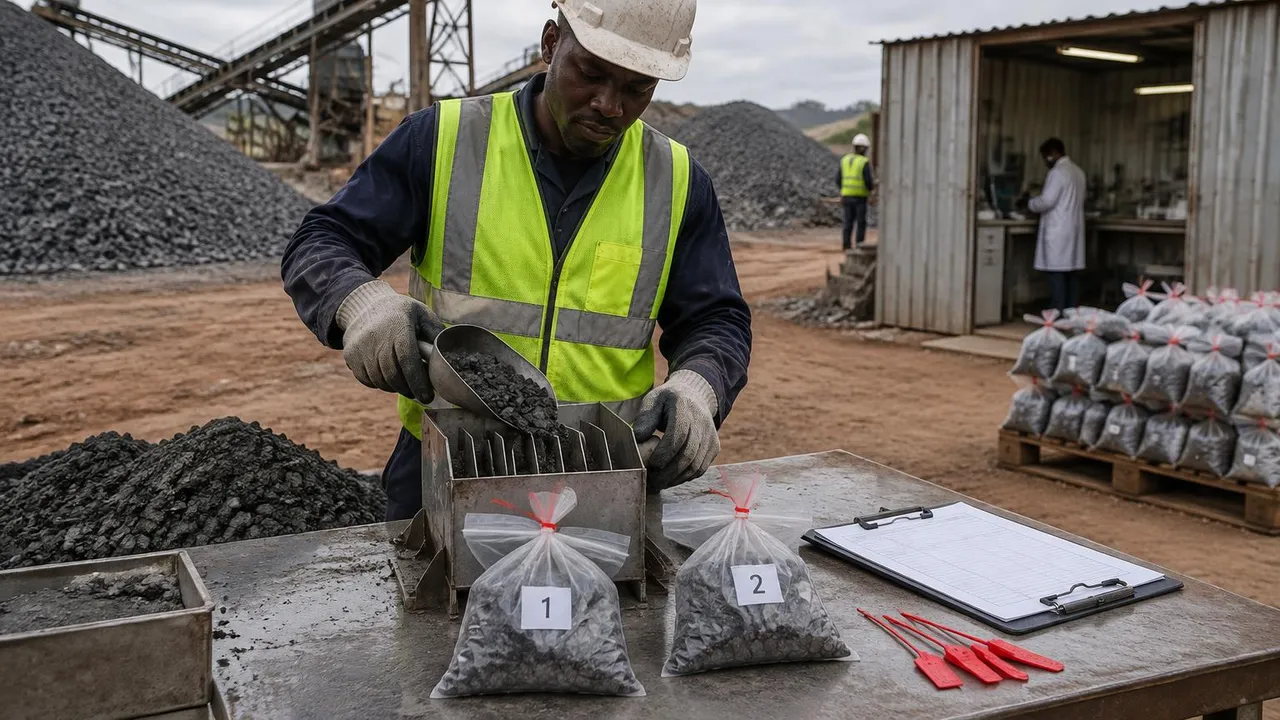
Seller assay certificates are useful indications but not settlement evidence. Agree in writing who samples, at which location, by which method, which independent laboratory analyses the samples, how many sealed samples are retained and by whom, and which umpire laboratory resolves disputes beyond an agreed tolerance. For concentrates such as copper, cobalt, coltan and cassiterite, state whether results are on a wet or dry basis and how moisture is measured. For lithium, agree the assay basis (for example Li₂O content) and deleterious elements. For gold, confirm fineness by independent assay rather than relying on hallmarks or photographs.
- Sampling witnessed by an independent inspector
- Named independent laboratory and umpire laboratory
- Sealed, labelled retention samples with documented custody
- Wet/dry basis, moisture method and penalty elements agreed
5. Permits and export documentation
Documentation
The export file should exist before cargo moves. Depending on mineral and route, it may include the exporter's authorisation, certificate of origin, ICGLR certificate where applicable, assay and weight certificates, proof of royalty and tax payment, commercial invoice, packing list and transport documents. In South Africa, precious-metal exports require the relevant regulator's permits. Every document should reference the same lot, weight and parties, and certificates should be verified with the issuing authority rather than accepted as copies.
6. Sanctions, KYC and AML
Screening
Screen the seller, owners, directors, intermediaries, banks and logistics providers against the sanctions lists applicable to you — commonly the UN Security Council lists (including the 1533 Committee for the DRC), US OFAC, EU and UK lists. Identify politically exposed persons and apply enhanced due diligence where they appear. The FATF Recommendations set the international baseline for customer due diligence; South African counterparties are subject to obligations under the Financial Intelligence Centre Act. Record what was checked, when and by whom.
7. Logistics and insurance
Delivery
Agree the Incoterms® rule and named place, and make sure the point where risk transfers matches the insurance cover in place. Clarify who arranges and pays for inland transport, border clearance, warehousing, inspection, security and freight. Inland DRC cargo frequently crosses neighbouring corridors to reach ports, while South African shipments typically move via Durban or other national ports or by air for precious metals; custody records must continue across each transfer. Request the actual insurance certificate, check the insured value, named parties and exclusions, and confirm the insurer directly.
8. Payment safeguards
Payment
Payment structure is one of the strongest controls a buyer has. Prefer instruments that release funds against verified documents and independent inspection — such as documentary letters of credit or bank-administered escrow — over advance transfers. Link each payment to a defined milestone, such as an independent assay result or a bill of lading naming the agreed lot. Never pay a party other than the contracting seller, and verify any change of bank details by an independent call to a known contact.
9. Red flags
Warning signs
The following signals do not prove wrongdoing, but each one justifies pausing until it is resolved in writing:
- Up-front fees for 'release', 'customs', 'certificates' or 'storage' before any verification
- Prices well below prevailing benchmarks or quantities inconsistent with the stated site
- Refusal to name the origin site or allow independent inspection and sampling
- Payment requested to a third party, a personal account or in cash
- Documents with inconsistent weights, lot numbers, names or dates
- Pressure to sign quickly or to skip KYC and sanctions screening
- Claims of government, central-bank or refinery endorsement that cannot be confirmed with that body
Putting the framework to work
A supplier evaluation is complete when each item above is supported by a document the buyer has checked — not merely received. If you are preparing a requirement for DRC or South African material, share the mineral, product form, specification, quantity, destination and your documentation expectations with our trade desk. Any discussion remains subject to verification and does not imply availability, price or delivery.